Exploring the Bliss of the San Blas Islands Gunayala History Culture and Governance
- sheri1943
- Apr 8
- 8 min read
The San Blas Islands, known locally as Guna yala, offer a unique glimpse into a vibrant indigenous culture that has thrived for centuries along the Caribbean coast of Panama. This archipelago is not only a stunning natural wonder but also a living example of indigenous self-governance, rich traditions, and a deep connection to the land and sea. Understanding Gunayala’s history, government, land ownership, religion, and culture reveals how the Guna people maintain their identity and autonomy in a rapidly changing world.

History of the San Blas Islands and the Guna People
The Guna people have inhabited the San Blas Islands for hundreds of years, long before the arrival of Europeans in the Americas. Their ancestors migrated from the mainland to the islands, seeking refuge from colonial pressures and conflicts. The archipelago consists of approximately 365 small islands and cays, many of which are inhabited by Guna communities.
Panama became independent in 1903 and the Guna resisted attempts by the Panamanian government to assimilate them and suppress their customs. they tried to ban their traditional dress (molas and noserings), foced schooling in Spanish and forced Christian religion This resistance culminated in the 1925 Guna Revolution, a pivotal moment when the Guna asserted their right to self-determination. At this time the US had major involvement with the Panama canal and US diplomat Richard O. Marsh intervened to mediate and reach a settlement, otherwise it would have been crushed and the Guna culture would have been erased. The rebellion led to the recognition of Gunayala as an autonomous territory within Panama, allowing the Guna to govern themselves according to their traditions.
Government and Autonomy in Gunayala
Gunayala operates as an autonomous indigenous territory with a political system rooted in Guna traditions. The government is organized around local communities called “congresos”, which are assemblies of representatives from each island. These congresses elect a Saila, or chief, who serves as the political and spiritual leader. Per our contacts, there are approximately six local tribes that comprise Gunayala: the Nobebugle, the most numerous with approximately 200,000 members, the Gunas, who number 100-130,000, the Waunan, the Enibena, the Bribri, and the Naso tribes.
The Guna General Congress, based in the capital, Narganá, oversees the broader governance of the territory. This body manages relations with the Panamanian state and external entities while protecting Guna laws and customs. The system balances traditional leadership with modern administrative functions, ensuring that decisions reflect the community’s values and needs.
Land Ownership and Environmental Stewardship
Land ownership in Gunayala is communal and deeply tied to Guna identity. The islands and surrounding waters belong collectively to the Guna people, who manage them through customary laws. Individual families have rights to specific plots for housing and farming, but the land itself cannot be sold or transferred outside the community. Many of the islands reportedly had several families that shared partial ownership for generations.
This communal approach supports sustainable use of natural resources. The Guna practice traditional fishing and agriculture methods that preserve the delicate island ecosystems. Their respect for the environment is evident in how they protect coral reefs, mangroves, and tropical forests, which are vital for their survival and cultural practices.

Religion and Spiritual Beliefs
Religion in Gunayala blends indigenous spirituality with elements of Christianity introduced during colonial times. The Guna maintain a strong connection to nature spirits and ancestral traditions. Rituals often involve offerings to the sea, forests, and other natural forces that sustain life.

We met Ibin (Ivin), the owner of Ibin's Beach Resort and Restaurant on Bandedup (Bug Island) in the east end of the Hollandes chain of Islands. Ibin is the grandson of a shaman and he speaks better English than I speak Spanish, so he was able to talk to me more about Gunayala people and some of their more esoteric beliefs. His daughter manages the restaurant when he is away and was amused that I was asking questions about the many murals they have in the restaurant that show aliens, mermaids, and reptilian half-humans, UFOs, etc. Like many other cultures separated by thousands of miles of oceans, the Guna people believe in all of these things. Ibin explained their origin stories and some of their current day religious practices.


The Saila plays a central role in religious ceremonies, acting as a mediator between the spiritual and physical worlds. Traditional dances, music, and colorful body paint are integral to these events, reinforcing community bonds and cultural continuity. In some cases, Ibin estimated twenty per year, child sacrifices still occur. It seems that these are used in order to keep power or prosperity. Ibin insinuated that it was similar to what is happening in America .with Epstein and his circle. (Ibin is very astute!)
Christianity, particularly Catholicism, has been adapted into Guna beliefs without replacing their original practices. This syncretism allows the Guna to honor both their heritage and the influences of outside religions.


Culture and Daily Life in Gunayala
Guna culture is rich with art, language, and customs that have been preserved through generations. The Guna language is widely spoken and taught in schools alongside Spanish, helping maintain cultural identity. Most of the locals we encountered speak Spanish, even the oldest woman we met who was 79. Speaking Spanish is definitely a plus when dealing with the tourists coming from Panama and the sailing community. Many of the locals have turned their home shacks into restaurant/bars of sorts where they offer fresh fish and coconut rice dishes, and limited beverages, but always bottled water and canned Balboa beer.


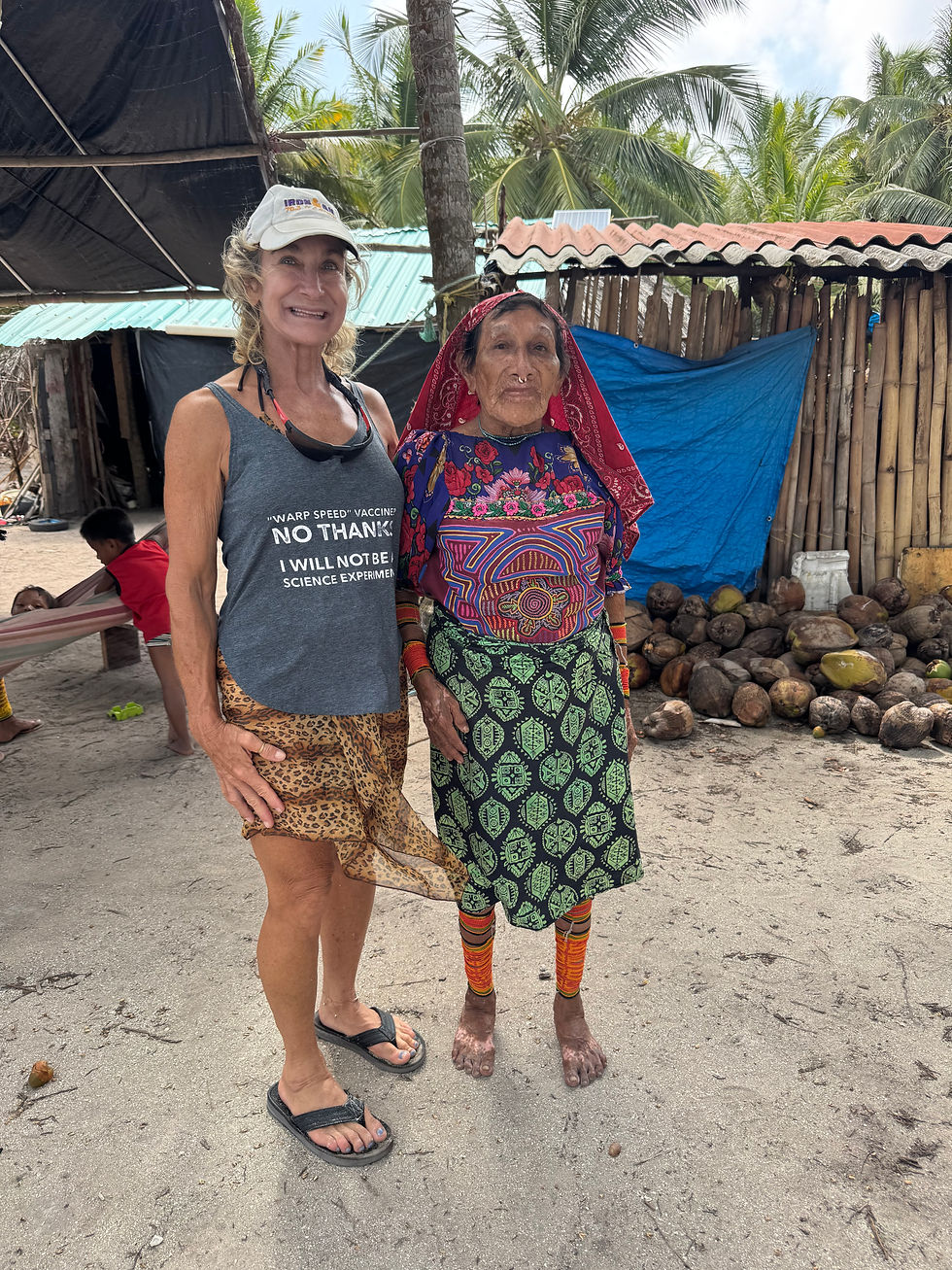


One of the most recognizable aspects of Guna culture is the mola, a hand-made textile art form. Molas are colorful panels sewn into clothing, featuring intricate geometric patterns and depictions of animals or plants. These textiles are not only artistic expressions but also symbols of Guna heritage and storytelling. We visited several different islands to examine the different molas and found the local people had started incorporating their mols into handbags, ties, and other westernized gear.
Daily life in Gunayala revolves around fishing, farming, and craft-making. The Guna diet includes seafood, tropical fruits, coconut rice and root vegetables, reflecting their island environment. Community gatherings, storytelling, and festivals are common, strengthening social ties and passing knowledge to younger generations.


Challenges and Future Outlook
Despite their autonomy, the Guna face challenges such as sanitation, trash disposal, damage to their ecosystem with thoughtless anchoring and over-fishing. The Guna government and international partners are working on adaptation strategies to protect the islands and their people. The local people are not concerned about "climate change", or sea levels rising as they know the climate has changed for tens of centuries. They have thriving coral reefs in just a few feet of very warm water which illustrates that it is not the warming of the water that kills the coral and sealife. The contaminants that Americans put in their waters via sewage, cloud-seeding, pesticides, mosquito control, etc is what has ruined our reefs.

Tourism offers economic opportunities but also risks disrupting traditional ways of life. The Guna carefully regulate visitors to ensure respect for their culture and environment. There was a $130 fee to clear into the country at Porvenir, and another $10 for a month stay in Hollandes. Many local fishermen would paddle their dugout canoes by the boats in the anchorage to sell fish, conch, lobster, and fresh fruit they had collected from the jungle on the mainland. We were happy to support them and the local "restaurant/bar" workers and tipped them with various triathlon and marathon t-shirts we brought along, and toothbrushes and paste (graciously provided by my dentist Dr. Matt Peterson). The bubbles for the kids were a big hit! (Thank you Donna Moffitt!).


We did eat out quite a bit since a three course meal for four (with beverages) was $100. Lunches or dinners were usually $10-$15 per person for ceviche, octopus, or occasionally chicken. There were no nearby stores from which to get produce or any staples, but occasionally one might find a few staples at one of the beach bars.
While in Gunayala, we were forbidden from scuba-diving, spear-fishing, kite-boarding, windsurfing, water-skiing, flying drones, touching marine life, or having pets. The pet rule is not strongly enforced since our friends were allowed their two Portuguese waterdogs and we met several local dogs and puppies on various islands. Education and healthcare improvements are ongoing priorities to support community well-being.
While we did obey the laws here, having plenty of lobster, conch and fish from the Bahamas and etc, we know of others that were spearing quietly for subsistence. We also saw someone attempting to kite-board but I think local authorities that patrol on their panga boats intervened.
The resilience of the Guna people lies in their ability to adapt while holding onto their identity. Their governance model and cultural practices provide valuable lessons in sustainability and indigenous rights. It will be interesting to see how this country looks in ten or twenty years, since it is becoming a center for tourism after one of the major sailing blog shows featured them on Youtube, It certainly was well-worth the time we spent there to live very simply and see how other cultures do the same, happily and healthfully.


Next stop: Back to Shelter Bay Marina in Panama to prepare for our first Panama Canal crossing April 5th and 6th, aboard our friends' catamaran, Takaya VI.


Comments